My Listings

My Listings
Browse my web site

Monday, June 1, 2020

4 Signs That Pests Are Wrecking Your Roofing

4 Signs That Pests Are Wrecking Your Roofing: While you might think it's easy to determine a pest infestation, that's not always the case. Here are four signs that pests are wrecking your roofing.

Saturday, May 30, 2020


Share This Post Now!

It may sound trite now, but it’s still painfully true: COVID-19 has changed our world in unprecedented ways. And it’s continuing to have a paralyzing effect on REALTORS® in ways no one could have imagined.

Many changes spurred by the pandemic likely won’t go away, even when restrictions are lifted. Trends toward remote sales, staged and live video home tours, and a mobile experience—especially among millennial and Gen-Z house hunters—will continue to challenge the sector.

But here’s the thing: REALTORS® aren’t the type who give up easily. They’re always ready to take on a challenge and push through to the goal line.

So what’s something you can you do now to ensure you keep your business growing and ahead of these challenges? Easy. Leverage verified real estate technology tools so you can meet buyers and sellers where they are and where they want to be: their phones.

To gain a competitive edge in today’s market, it’s important to offer more than just a standard video tour that anyone can do with a phone. The professionals who will truly stand out from the crowd will be the ones who go the extra mile (or rather, megabyte) for their clients.

Here are some quick tips:

 Encourage clients to share a digital checklist of their must-see items beforehand so you can be sure to complete them during the tour.

Tag key points during the livestream so you can give clients one-click access to them in the post-tour video replay.

Provide clients with a way to find and scope out properties of interest without requiring MLS access.

And if you really want to differentiate yourself? Use a single solution that consolidates everything you need and is designed for real estate. That way, you can give your clients a unified and value-driven experience with your homes and avoid important messages getting spread out (and lost) across different apps.

A great example of this is a new smartphone app called HomeRover that launched in April. Available for both Apple and Android devices, HomeRover is free for buyers and REALTORS® (there’s a nominal fee of $4.95/month to host tours). Everything you and your clients need is built right into the app.

Thursday, May 28, 2020

Buyers are back!

Jump in mortgage applications for home purchases shows buyers are back

Purchase apps last week were 6.7% higher than a year ago, MBA says

Applications for mortgages to purchase homes gained for the sixth consecutive week to a level that was 6.7% higher than a year ago, back when a deadly pandemic wasn’t interrupting the spring home-buying season.

A seasonally adjusted index measuring purchase applications jumped 9% last week, according to a report from the Mortgage Bankers Association. Applications for refinancings fell 0.2% from the prior week, though the level was 176% higher than a year ago, MBA said.

Last week’s so-called purchase apps were up 54% from early April when most U.S. states were under lockdown orders to keep people at home in an effort to stem the spread of COVID-19, said Joel Kan, MBA’s associate vice president of economic and industry forecasting.

“The housing market is continuing its path to recovery as various states reopen, leading to more buyers resuming their home search,” said Joel Kan, an MBA associate vice president.

The surge in purchase demand drove the overall index, measuring both purchase and refi applications, higher by 2.7% on a seasonality adjusted basis from the prior week, the report said.

Demand is being driven by a shortage of homes on the market that preceded the epidemic, coupled with mortgage rates near the lowest level ever recorded.

The supply of properties on the market at the end of April was 1.47 million, the National Association of Realtors said last week. That’s the lowest level ever recorded for the month, said Lawrence Yun, NAR’s chief economist.

Last week, the average U.S. rate for a 30-year fixed mortgage dropped to 3.24%, within one basis point of the all-time low set two weeks earlier, according to Freddie Mac.

The share of applications for mortgages backed by the Federal Housing Administration decreased to 11.2% from 11.5% in the week prior, the report said. The share of applications backed by the Veterans Administration fell to 12.4% from 13.4%, the report said.

Tuesday, May 26, 2020

Fannie Mae, Freddie Mac will allow borrowers who took forbearance to refinance their mortgage


May 19, 2020, 12:02 pm By 

The most recent data shows that there are approximately 4.1 million borrowers in forbearance on their mortgage, but a lack of clarity in the wording of the CARES Act was leaving many of those borrowers unable to take advantage of the recent record lows in interest rates.

But that’s not the case anymore.

The Federal Housing Finance Agency announced Tuesday morning that Fannie Mae and Freddie Mac will now allow borrowers who went into COVID-19 forbearance to refinance their loan or buy a new home with the support of the GSEs as long as they’ve made three straight months of payments after their forbearance ends.

That’s much different from the previous thinking that a borrower may not be able to get another GSE mortgage for as many as 12 months after they exit forbearance.

The CARES Act stipulates that mortgage servicers “shall report the credit obligation or account as current” on any loan that goes into COVID-19-related forbearance.

But, as HousingWire’s Kathleen Howley reported last week, some borrowers were seeing notations on their credit reports like “Account in forbearance, payment deferred.’’

That was creating a problem for borrowers who were ready to exit forbearance or those who got put into forbearance by accident. As Howley wrote, the sentiment among loan officers was that any notation of “forbearance” on a borrower’s credit file would prevent them from getting another GSE-backed mortgage, either through a refi or buying a new home, for 12 months.

Now, the GSEs are shaving nine months off of that waiting period, which would allow more borrowers to take advantage of the market’s low interest rates instead of being shut out for a year.

According to the FHFA, borrowers are now eligible to refinance or buy a new home with GSE backing three months after their forbearance ends as long as they’ve made three consecutive payments under their repayment plan, or payment deferral option or loan modification.

Also, borrowers who went into forbearance (either of their own volition or by accident, as happened to some borrowers) but continued to make their mortgage payments are eligible to refinance or buy a new home as long as they are current on their mortgage.

Here, from Fannie Mae, are more details on how borrowers who either requested and/or accepted forbearance may be eligible for a refi or new mortgage:

Under the temporary eligibility guidelines, effective immediately, homeowners who missed payments and entered into a loss mitigation solution – such as a repayment plan, payment deferral, or loan modification – are eligible for a new refinance or purchase mortgage after three timely payments.

There is no waiting period for borrowers who missed payments due to a COVID-19 financial hardship but have since completed reinstatement by repaying the full amount of the outstanding payments missed during the forbearance period.

There also is no waiting period for borrowers who requested forbearance due to a COVID-19 financial hardship but ultimately were able to make all their payments in full and on time.

“Homeowners who are in COVID-19 forbearance but continue to make their mortgage payment will not be penalized,” FHFA Director Mark Calabria said. “Today’s action allows homeowners to access record low mortgage rates and keeps the mortgage market functioning as efficiently as possible.”

But that’s not the only change the GSEs announced today.

Last month, Fannie and Freddie announced that they would begin buying loans that went into first-payment forbearance, meaning those where the borrower went into forbearance within one month of the loan closing.

That policy was set to expire on May 31, but the FHFA said Tuesday that the GSEs are extending it through August 31, 2020.

“The Enterprises are now able to buy forborne loans, with note dates on or before June 30, 2020, as long as they are delivered to the Enterprises by August 31, 2020 and have only one mortgage payment has been missed,” the FHFA said Tuesday. “FHFA and the Enterprises will continue to monitor the impact of the coronavirus national emergency on the housing finance market and update our policies as necessary.”

[Update: This article is updated with more information on the announcement from Fannie Mae.]

Leave a comment

Friday, May 22, 2020

How is Florida Fairing during the Pandemic?


Florida closings for single-family homes were up 10.2 percent YoY in the first quarter of 2020. Median sale prices were up for existing single-family homes, increasing 6.7 percent to $270,000. The condo-townhouse market? Closed sales totaled 27,379 in the first quarter, up 9.3 percent YoY. Inventory was at a 3.4 months supply for single-family homes in Q1, and at a 5.5 months supply for condo and townhouses.

“Compared to the same quarter last year, total residential sales were up in the first quarter of 2020 across all 22 Florida metro areas,” said Florida REALTORS® Chief Economist Dr. Brad O’Connor. “Remember, going into the first quarter last year, the stock market was somewhat in flux and we had just entered the longest-ever shutdown of the federal government. So, home sale activity was a bit slow to start off. By March, though, falling mortgage rates came to the rescue, and sales started taking off. Mortgage interest rates are currently lower than they were even back then, though, so it’s no wonder our first quarter sales numbers for 2020 were so strong.”

“Obviously, we are not expecting a repeat performance in Q2 due to the coronavirus outbreak,” added O’Connor. “While we expect prices to remain stable through Q2, we will certainly see a reduced number of completed transactions.”

Source: Florida REALTORS®

Thursday, May 21, 2020

Spring Cleaning Tips for a Safe Environment

Spring Cleaning Tips for a Safe Environment: This year, spring cleaning takes on a whole new meaning as the world works hard to prevent the spread of COVID-19. Here are some helpful cleaning tips.

Tuesday, May 19, 2020

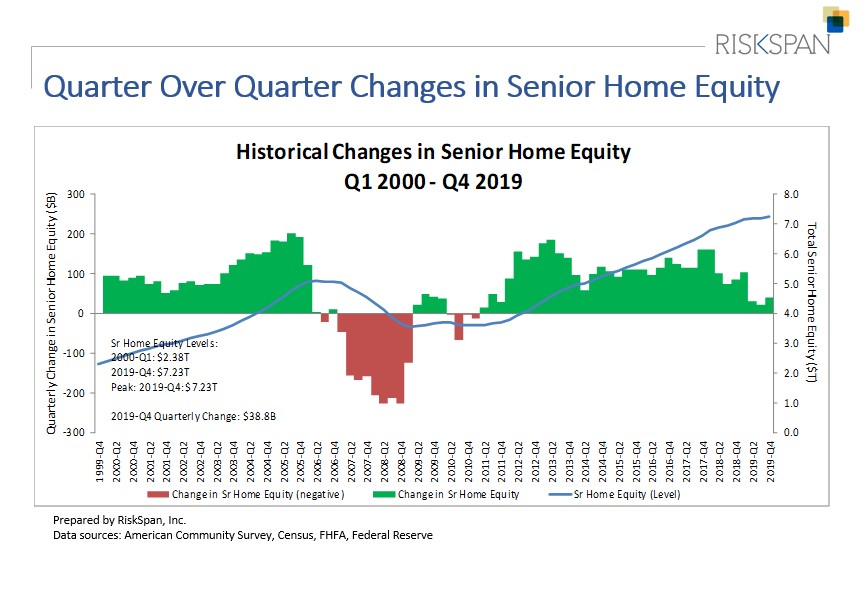
Senior Housing Wealth Reaches Record $7.23 Trillion

Contact:
Darryl Hicks, 202-939-1784, dhicks@dworbell.com
National Reverse Mortgage Lenders Association

For Immediate Release:

WASHINGTON (April 2, 2020) – Homeowners 62 and older saw their housing wealth grow by 0.5 percent or $39 billion in the fourth quarter to a record $7.23 trillion from Q3 2019, the National Reverse Mortgage Lenders Association reported today in its quarterly release of the NRMLA/RiskSpan Reverse Mortgage Market Index.

The RMMI rose in Q4 2019 to 260.52, another all-time high since the index was first published in 2000. The increase in senior homeowners’ wealth was mainly driven by an estimated 0.6 percent or $55 billion increase in home values, offset by a one percent or $16.6 billion increase of senior-held mortgage debt.

“The responsible use of home equity may be an option to help seniors stay financially secure during the current market disruptions,” says NRMLA’s President Steve Irwin.

About Reverse Mortgages
Reverse mortgages are available to homeowners age 62 and older with significant home equity. They are a versatile financial tool that seniors can use to borrow against the equity in their home without having to make monthly principal or interest payments as with a traditional “forward” mortgage or a home equity loan. Under a reverse mortgage, funds are advanced to the borrower and interest accrues, but the outstanding balance is not due until the last borrower leaves the home, sells or passes away.

To date, more than 1.12 million households have utilized an FHA-insured reverse mortgage to help meet their financial needs. For more information, please visit www.ReverseMortgage.org

About the National Reverse Mortgage Lenders Association
The National Reverse Mortgage Lenders Association (NRMLA) is the national voice for the industry and represents the lenders, loan servicers, and housing counseling agencies responsible for more than 90 percent of reverse mortgage transactions in the United States. All NRMLA member companies commit themselves to a Code of Ethics & Professional Responsibility. Learn more at www.nrmlaonline.org

About RiskSpan, Inc.
RiskSpan offers end-to-end solutions for data management, risk management analytics, and visualization on a highly secure, fast, and fully scalable platform that has earned the trust of the industry’s largest firms. Combining the strength of subject matter experts, quantitative analysts, and technologists, the RiskSpan platform integrates a range of data-sets–including both structured and unstructured–and off-the-shelf analytical tools to provide you with powerful insights and a competitive advantage. Learn more at www.riskspan.com.